中文
lapel pins guide
A lapel pin can carry a company logo, recognize an achievement, identify a member or commemorate an event. It can also become artist merchandise, a destination souvenir or a collectible. Choosing the right construction helps the design work as a physical product.
How do you choose a lapel pin? Start with its purpose and the appearance you want. Compare soft enamel for raised metal borders and recessed colors, hard enamel for a comparatively smooth surface, uncolored metal for relief and texture, printing for photographic or gradient artwork, and 3D metal for sculpted depth. Then check the actual size, backing, packaging and order specifications.
This guide helps you compare the options, identify what needs reviewing and prepare a useful inquiry for Baijisen. If you already have artwork, you do not need to decide every specification before starting the discussion.
Prepare Your Quotation Brief Explore Baijisen Lapel Pins
Quick Selection: Start with the Result You Want
| Your priority | Compare first | Confirm next |
|---|---|---|
| Defined colors and visible surface texture | Soft enamel | Metal borders, small fill areas and any coating |
| A comparatively level, smooth surface | Hard enamel | Detail reproduction and finish compatibility |
| Metal relief without enamel colors | Uncolored metal construction | Raised and recessed contrast |
| A photograph or continuous gradient | Printed construction | Image quality, final size and protective finish |
| Curved surfaces and sculpted depth | 3D metal construction | Modeling, thickness, weight and attachment |
These are selection directions, not guarantees of suitability. The actual artwork and specifications determine the final process.
What Are Lapel Pins?

Lapel pins are small accessories or identification pieces worn on jacket lapels, uniforms, hats, bags or other suitable surfaces. Their fronts may feature logos, emblems, lettering, illustrations or dimensional metal designs.
The rear attachment secures the product. A pin post and clutch is one option; magnetic and other fastening constructions may also be considered for specific applications.
Lapel Pin vs. Enamel Pin: What Is the Difference?
“Lapel pin” describes a product category and wearing use. “Enamel pin” describes a pin with enamel-filled color areas. Many enamel pins are lapel pins, but lapel pins can also use printing or uncolored metal.
| Term | Main meaning | What to specify |
|---|---|---|
| Lapel pin | A small wearable or display product | Artwork, construction, size and attachment |
| Enamel pin | A pin using enamel color fill | Enamel type, colors and metal boundaries |
| Brooch | A decorative accessory with potentially different proportions and hardware | Weight, ornamentation and fastening structure |
| Pin-back button | A badge commonly using a shell and printed-image construction | Base structure, image presentation and attachment |
Product names alone can be ambiguous. Include a reference image and describe the surface effect you want when contacting a supplier.
Understand the Different Levels of Classification
Die striking and casting describe forming methods. Enamel and printing describe ways of presenting colors and artwork. “3D” describes a dimensional effect. These terms are not always mutually exclusive.
For example, a die-struck base can receive enamel fill. If you want an all-metal appearance, specify that no enamel color is required.
Soft Enamel vs. Hard Enamel Lapel Pins
The most useful initial difference is the surface profile: soft enamel typically leaves color below the raised metal borders, while hard enamel is finished to create a comparatively level surface.
When to Consider Soft Enamel
Compare soft enamel when the design benefits from visible metal outlines and a textured surface. It can be a suitable starting point for logos, mascots and illustrations with clearly separated color areas.
Review small fill spaces, thin lines and lettering. A clear coating, if requested, can alter the finished texture and reflection, so treat it as a separate specification.
When to Consider Hard Enamel
Compare hard enamel when a smooth surface is part of the design brief. It can be considered for corporate logos, recognition products, commemorative gifts and retail merchandise.
Confirm whether the fine details and requested metal finish suit the selected process. Surface treatment can affect how small elements are reproduced.
| Question | Soft enamel | Hard enamel |
|---|---|---|
| What is the typical profile? | Recessed color below raised metal lines | Color and metal finished at a similar level |
| What should the artwork emphasize? | Distinct borders and separated color areas | A layout compatible with filling and finishing |
| Can it reproduce continuous gradients? | Traditional fill generally uses separated solid colors | Traditional fill generally uses separated solid colors |
| Is one always less expensive? | Compare quotations using the same design, dimensions, quantity, finish, attachment and packaging. | |
| Is one universally better? | No. The appropriate choice depends on the desired appearance and project specifications. | |
Do not select a process solely because it is described as “premium.” Decide which physical characteristics matter to the intended recipient and use.
Metal, Printed and 3D Lapel Pin Options
Uncolored Metal Pins
Without enamel, the design is carried by raised metal, recessed areas, texture and finish. This approach can suit emblems, anniversary symbols and metal-focused designs.
Check the contrast between lettering and its background. Polished and textured areas may help distinguish elements, but the result should be evaluated for the actual design.
Printed Pins
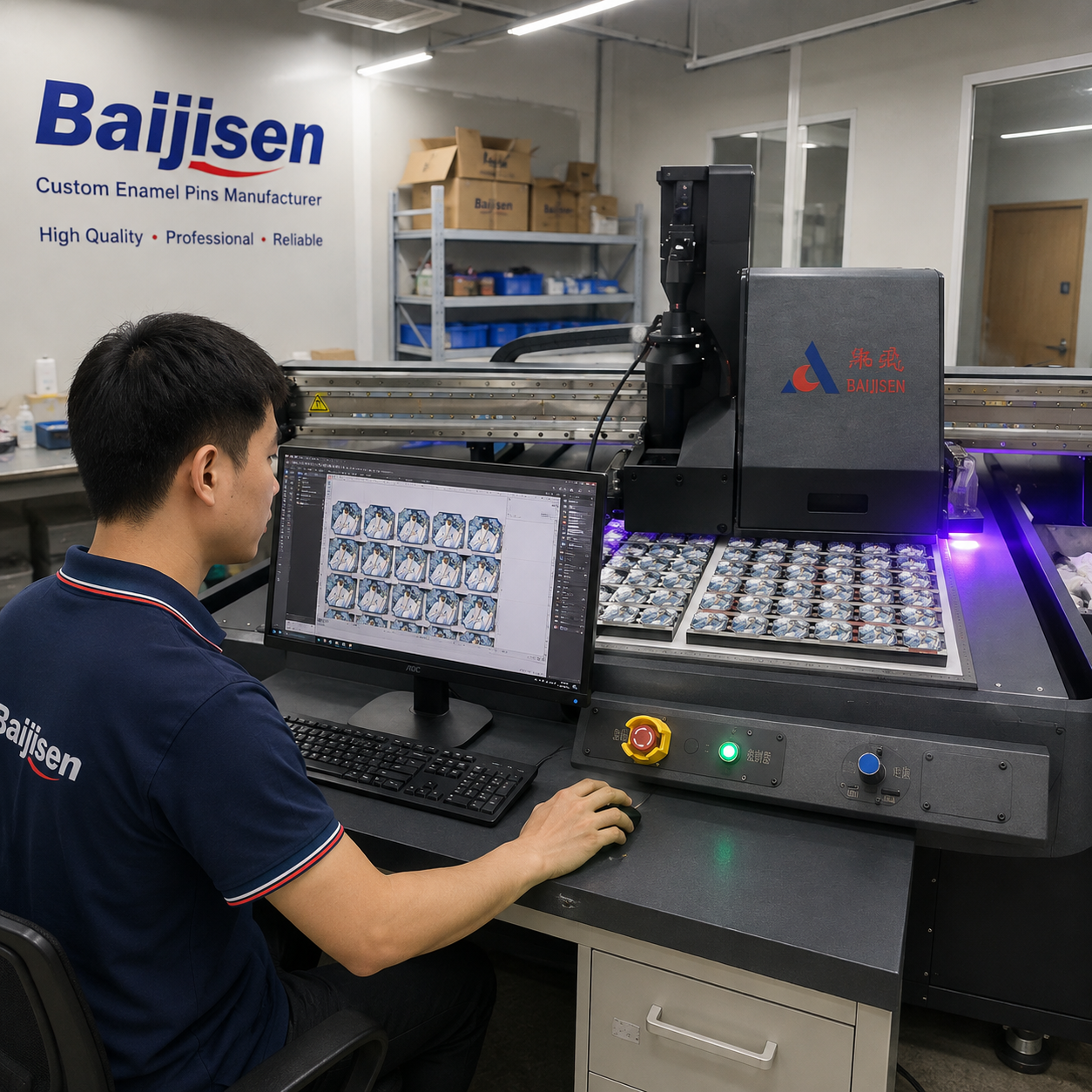
Printing may be appropriate for photographs, continuous gradients and artwork that does not translate well into metal-separated color areas.
Confirm the printing method rather than treating all printed options as identical. Also review the image resolution, base, edge treatment and any protective coating. Printing cannot make every detail readable at a small size.
3D Metal Pins
Sculpted relief and curved surfaces can give a subject visible volume. Discuss the intended depth, front profile, thickness, weight and attachment together.
Identify narrow projections or unsupported sections before production. For projects where shape and reflection are critical, discuss modeling and physical sample review.
Special Effects and Additional Features
Depending on feasibility, a project may include decorative enamel effects, printed details, engraving, numbering or cutouts. Bring these requirements into the initial discussion: they may affect the layout, process, price and schedule.
Choose Lapel Pins for the Intended Application
Corporate Logos and Recognition Programs

Prioritize a recognizable logo and readable recognition information. A complete promotional layout usually needs adaptation before it becomes a compact metal accessory.
For service awards, identify each year or level and its quantity. Confirm whether changes in text, structure or finish require separate setup.
Events and Promotional Distribution

Determine who will receive the pins and how they will be distributed. Individual bags, branded cards and sorting by location or recipient group can affect packing requirements.
Provide the required arrival date, not only the event date. Artwork approval, samples, manufacturing and transit need to fit within the available time.
Schools, Clubs and Associations

A clear emblem, short name and relevant year can help communicate membership or achievement. Longer explanations can appear on a presentation card instead of the pin.
For products intended for children, discuss applicable target-market requirements and actual use conditions.
Retail, Artist Merchandise and Collectibles
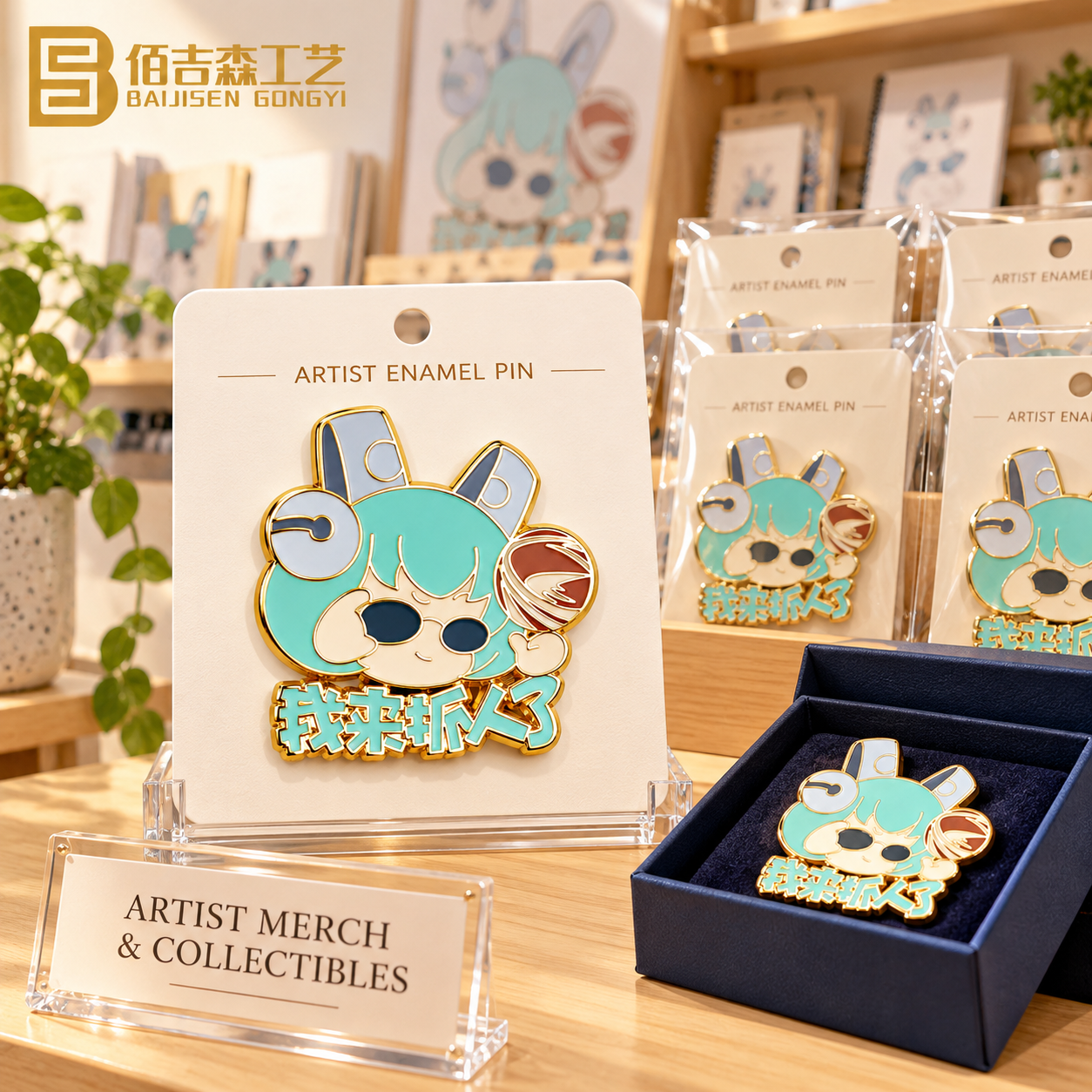
Consider the pin and its presentation as one product. Coordinate series artwork, backing cards, labels, SKU identification and replenishment specifications.
Confirm authorization before using third-party characters, trademarks or artwork.
How to Choose Lapel Pin Size, Shape and Finish
Size: Evaluate the Artwork and Wearing Position
Additional area can improve spacing, but larger dimensions may increase weight and change how the pin sits on fabric. A small, simple symbol can work differently from a seal containing several lines of text.
| Size | Metric equivalent | Review question |
|---|---|---|
| 0.75 inch | 19.05 mm | Can the main symbol remain clear without secondary text? |
| 1 inch | 25.40 mm | Are the logo and essential lettering distinguishable? |
| 1.25 inches | 31.75 mm | Does extra space improve the layout enough to justify the size? |
| 1.5 inches | 38.10 mm | How do weight and attachment affect the intended garment? |
These are examples, not universal size recommendations. Specify maximum width and height for an irregular shape. Discuss thickness separately.
Use an Actual-Size Check
- Print the proposed artwork at the intended dimensions.
- Verify that the print settings have not resized the design.
- Check important lettering without enlarging it.
- Place a paper cutout on the intended garment or bag.
- Compare simplifying the artwork with increasing the size.
A paper cutout helps assess proportions, but does not reproduce the finished product's weight or stiffness.
Standard Shapes vs. Custom Outlines
Circles, rectangles and shields provide a defined layout area. A custom outline can follow a logo, character or object. Review sharp corners, thin extensions, narrow connections and attachment space.
Base Material vs. Surface Finish
Base material affects forming and structure; surface finish affects visible color, shine and texture. Specify both when the project has a material requirement.
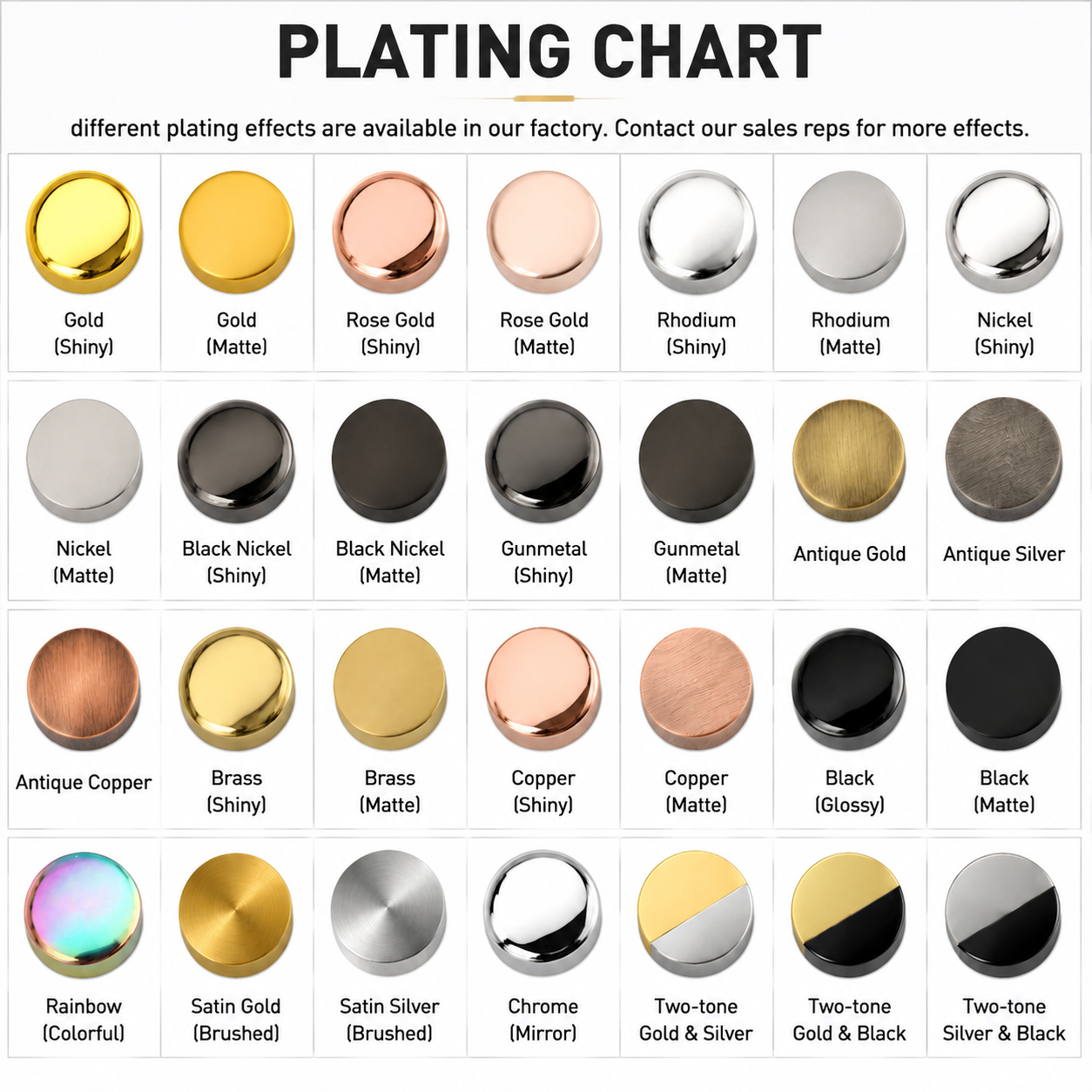
A gold-colored surface does not mean solid gold. Likewise, a silver-colored appearance does not establish sterling silver content. Agree any particular material or plating requirement explicitly.
Assess lettering against the chosen surface. Reflective metal and textured recesses can change readability under different lighting conditions.
Lapel Pin Backings and Post Placement
The attachment should support the product's dimensions, weight and use. Select it during design review, rather than after the front artwork has been approved.
| Option | What to evaluate |
|---|---|
| Butterfly clutch | Post compatibility, handling and holding performance |
| Rubber clutch | Grip, handling, appearance and fit with the post |
| Locking clutch | Locking and release operation and intended use |
| Magnetic attachment | Fabric thickness, pin weight and attachment construction |
| Single post | Balance, placement and possible rotation |
| Two posts | Orientation, spacing and installation requirements |
When Should You Discuss Two Posts?
A wide, elongated or asymmetrical pin may benefit from additional orientation control. Two posts also create two piercing points and need suitable spacing. Review the actual design rather than applying a single size threshold.
When Should You Discuss a Magnetic Attachment?
A magnetic construction can avoid a post passing through the fabric. Its suitability depends on the garment, pin weight and attachment design. Confirm use limitations and any relevant instructions.
No attachment should be assumed to work with every fabric or to remain secure under every movement.
Prepare Artwork That Works as a Physical Pin
Set a Clear Information Hierarchy
Identify the elements that must remain recognizable: the main logo, character or emblem. Next, prioritize essential wording. Treat small decorations and secondary information as adjustable.
Production preparation may involve changing a layout, simplifying details or assigning metal boundaries. Approve these changes before manufacturing.
Illustrative Example: Simplifying an Anniversary Pin
The following is a hypothetical design exercise, not a completed Baijisen order or a customer case study.
| Initial concept | Potential issue | Revision to evaluate |
|---|---|---|
| Logo, full company name, slogan and anniversary text | Too many competing elements at a compact size | Keep the logo and anniversary; move the slogan to the card |
| Several very small decorative color areas | Limited space for reliable fill and separation | Combine or simplify areas after artwork review |
| Gradient background | Not suited to traditional separated enamel fill | Compare printing with an approved solid-color adaptation |
| Long horizontal outline with one post | Possible rotation during wear | Review post count and placement |
The aim is to preserve the intended message while making the product readable and structurally appropriate. Exact production limits must be checked for the selected method and design.
Color References and Physical Appearance
Provide defined color references where available. Traditional enamel generally uses distinct color areas; photographic or continuous tonal artwork may call for printing.
Screens emit light, while enamel and metal reflect it. Do not assume identical appearance across monitors, printed documents and finished materials. Discuss a physical confirmation method for critical color requirements.
Useful Artwork Files
Editable vector files can help with dimension, outline and lettering adjustments. AI, EPS, SVG and vector PDF are useful starting formats, subject to the accepted workflow.
If these are unavailable, send a clear image, sketch or written concept. A PDF may contain a raster image, so the extension alone does not establish editability or quality.
Read Create Your Own Lapel Pin for a more detailed design and manufacturing guide.
What Affects Custom Lapel Pin Cost?
A meaningful quotation is based on specifications. Size, construction, quantity, design versions, finish, attachments and packaging all contribute to the project.
Specify Quantity for Each Design
Five hundred pieces of one design and five designs of one hundred pieces each can require different tooling and setup. List quantities by design and identify variations in wording, color, shape or rear markings.
Compare the Same Specifications
Two quotations are not directly comparable if one uses a different thickness, attachment, finish or packaging method. Ask each supplier to quote the same specification list.
| Item | What to confirm |
|---|---|
| Product | Width, height, thickness, process and design version |
| Tooling and setup | Included charges and conditions for repeat orders |
| Color and finish | Specified fill, plating and additional effects |
| Attachment | Backing type, post count and any rear markings |
| Packaging | Bags, cards, boxes, labels and sorting requirements |
| Samples | Review method, cost, schedule and approval arrangements |
| Delivery | Destination, shipping method and included charges |
Compare total project cost: product charges, applicable setup, attachments, packaging, optional services, shipping and applicable destination charges.
Not every category is charged separately on every order. Ask what the quotation includes.
Use Quantity Comparisons to Make a Decision
If you are deciding between order quantities, request comparable quotations for the same design. Compare the complete cost, storage needs and expected demand. A lower unit price does not necessarily justify buying more than the project needs.
For volume planning, see Custom Lapel Pins in Bulk .
Check These Details Before Approving Production
A digital proof documents the design and specifications. It does not fully reproduce weight, texture, reflections or sculpted appearance. Discuss physical samples when these features are important to acceptance.
| Approval area | Checklist |
|---|---|
| Artwork | Final logo, exact wording, spelling, dates, approved revisions and usage authorization |
| Dimensions | Width, height, thickness, outer shape and cutouts |
| Appearance | Color references, metal finish, relief and coatings |
| Rear structure | Backing, post count, placement and rear text |
| Order | Quantity by version, packaging, labels and sorting |
| Delivery | Approval timing, production plan, shipping method, arrival requirement and address |
| Acceptance | Sample review, agreed inspection criteria and issue-resolution arrangements |
Approve a clearly identified version. If the design changes, confirm that the artwork, quotation and production instructions are updated together.
Plan from the Required Arrival Date
A delivery plan may need to include artwork preparation, revision, sample review, manufacturing, inspection, packing and transport. Customs clearance may also affect arrival.
Ask for a schedule based on the actual project and destination. Confirm when the production clock starts and what changes could affect the agreed plan.

Custom Lapel Pin Projects with Baijisen

Kunshan Baijisen Craft Gift Co., Ltd. provides custom metal craft and gift manufacturing services. A lapel pin project can begin with a company logo, organization emblem, sketch, reference image or original product idea.
Share the Purpose Before Finalizing the Process
Tell Baijisen whether the pins are intended for recognition, an event, uniforms, retail or another application. Describe the desired appearance and any requirements for wearing, packaging or distribution.
Prepare the Information That Makes Review Useful
| Project question | Information to provide or confirm |
|---|---|
| Can we start without a final design? | Send the clearest available reference and explain which elements must be retained. |
| What does artwork support include? | Confirm the scope of drawing, production adaptation, revisions and any applicable fees. |
| What quantity can be ordered? | Provide quantities by design and confirm the minimum applicable to the requested construction. |
| How will the appearance be approved? | Agree the digital proof and any physical sample arrangements. |
| Can the packaging be customized? | Describe the card, bag, box, label or presentation requirements. |
| What is needed for an international delivery plan? | Destination country, postal code, arrival deadline and any special packing or documentation needs. |
Explore Baijisen lapel pin products and company information. For a broader customization overview, read Custom Personalized Lapel Pins .
Have Artwork but Need Help Choosing the Construction?
Send your artwork, intended use, quantity and target arrival date. Include any preferences for size, surface appearance, backing and packaging.
Email Your Project Requirements Visit the Product Page for Contact OptionsFrequently Asked Questions About Lapel Pins
What is the difference between a lapel pin and an enamel pin?
A lapel pin is a product category associated with wearing or displaying a small pin. An enamel pin uses enamel-filled color areas. Lapel pins can also use printing or uncolored metal.
Which lapel pin type should I choose for a company logo?
Compare the logo's colors, detail and desired surface. Enamel may suit separated color areas, uncolored metal may suit relief, and printing may suit continuous gradients. Have the actual artwork reviewed.
Is hard enamel always better than soft enamel?
No. Their surface profiles differ. Choose according to the appearance, artwork and project requirements rather than a universal quality ranking.
What size should my lapel pin be?
Check the proposed artwork at actual size and consider where it will be worn. Lettering, complexity, weight and backing all affect the decision.
Can photographs and gradients be reproduced?
A printed option may be suitable. Review the image resolution, physical dimensions, printing method and protective finish.
Can I start with a sketch or image?
Yes, these can provide a starting point for discussion. Confirm any required redrawing, adaptation and service charges.
When should I use two posts?
Discuss two posts when shape, balance or rotation makes orientation control important. The decision should be based on the actual design and wearing conditions.
Can a magnetic attachment avoid piercing the fabric?
It can avoid a post passing through the garment, but suitability depends on fabric thickness, weight and construction. Confirm limitations and use instructions.
What is the minimum order quantity?
Confirm the applicable minimum with Baijisen for the specific design and construction. State quantities for each version in your inquiry.
How much do custom lapel pins cost?
Pricing depends on dimensions, quantity, process, finish, attachments, packaging and delivery. Request a quotation based on a complete specification list.
How long do production and delivery take?
Request a project-specific schedule covering approval, manufacturing and transport. Provide the required arrival date and destination.
Will the digital proof exactly match the finished product?
The proof confirms artwork and specifications but cannot fully simulate physical texture, reflection or weight. Discuss sample review for critical appearance requirements.
Where should a lapel pin be worn?
Placement depends on the garment and occasion. See How to Wear a Lapel Pin for placement and wearing guidance.
Request a Custom Lapel Pin Quotation
Begin with the information you have. The most useful starting items are artwork or a clear description, quantity and intended use. Add dimensions and delivery requirements where available.
Project name:
Intended use:
Artwork or reference:
Essential design elements:
Preferred width and height:
Thickness requirement, if any:
Quantity for each design or version:
Preferred process, or recommendation needed:
Color references:
Metal finish:
Backing or wearing requirements:
Packaging and labels:
Delivery country and postal code:
Required arrival date:
Budget guidance, if available:
Questions requiring advice:
Discuss Your Lapel Pin Project with Baijisen
Share your logo, sketch or concept and project requirements to request a custom proposal. If the size or process is undecided, explain the result you want.
Request a Custom Lapel Pin QuoteEmail: postmaster@baijisen.com
Website: www.baijisen.com
Final specifications, service scope, minimum quantity, pricing, sample arrangements and delivery schedule are confirmed for the individual project.